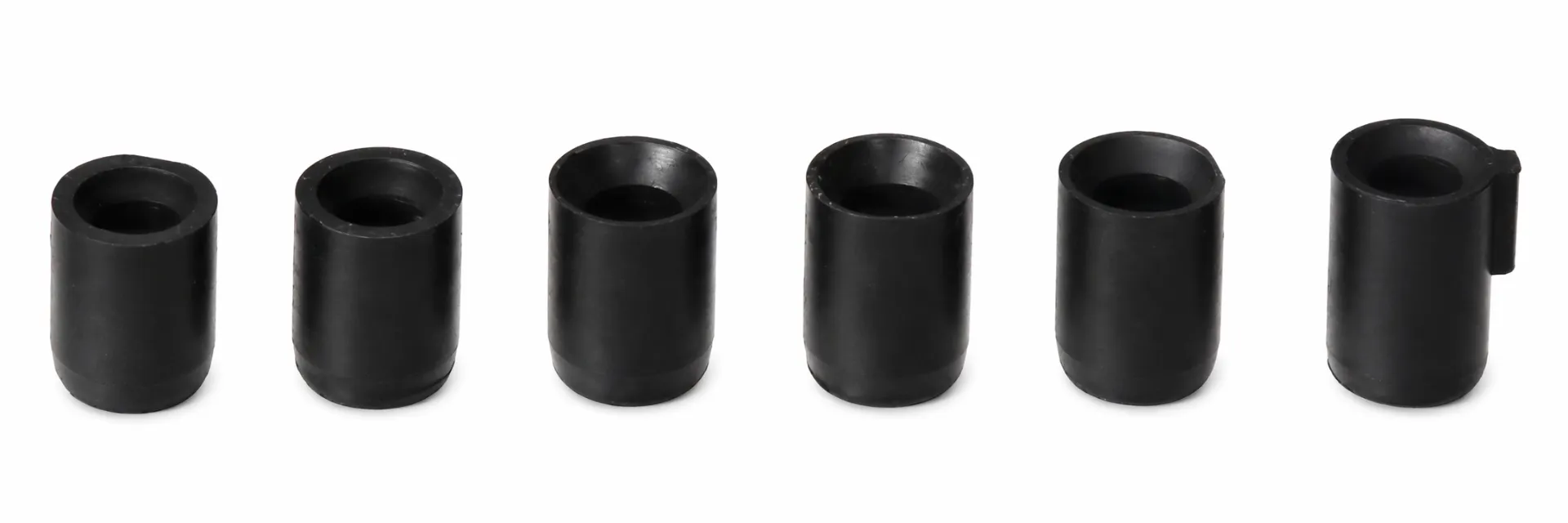
Why T-N.T. Uses Dedicated Buckings?
BB positioning is more important than you think.
One of the most common questions we receive from airsoft players is:
“Why do some T-N.T. HOP-UP chambers require a dedicated bucking?"
From a manufacturing perspective, using a single bucking specification across all platforms would certainly reduce development costs and simplify inventory management.
However, at T-N.T., our goal has never been to create products that simply function.
Our focus is achieving greater consistency, improved accuracy, and more stable ballistic performance.
The key to achieving this lies in one critical factor:
Whether the BB is positioned correctly and consistently when entering the HOP-UP system.
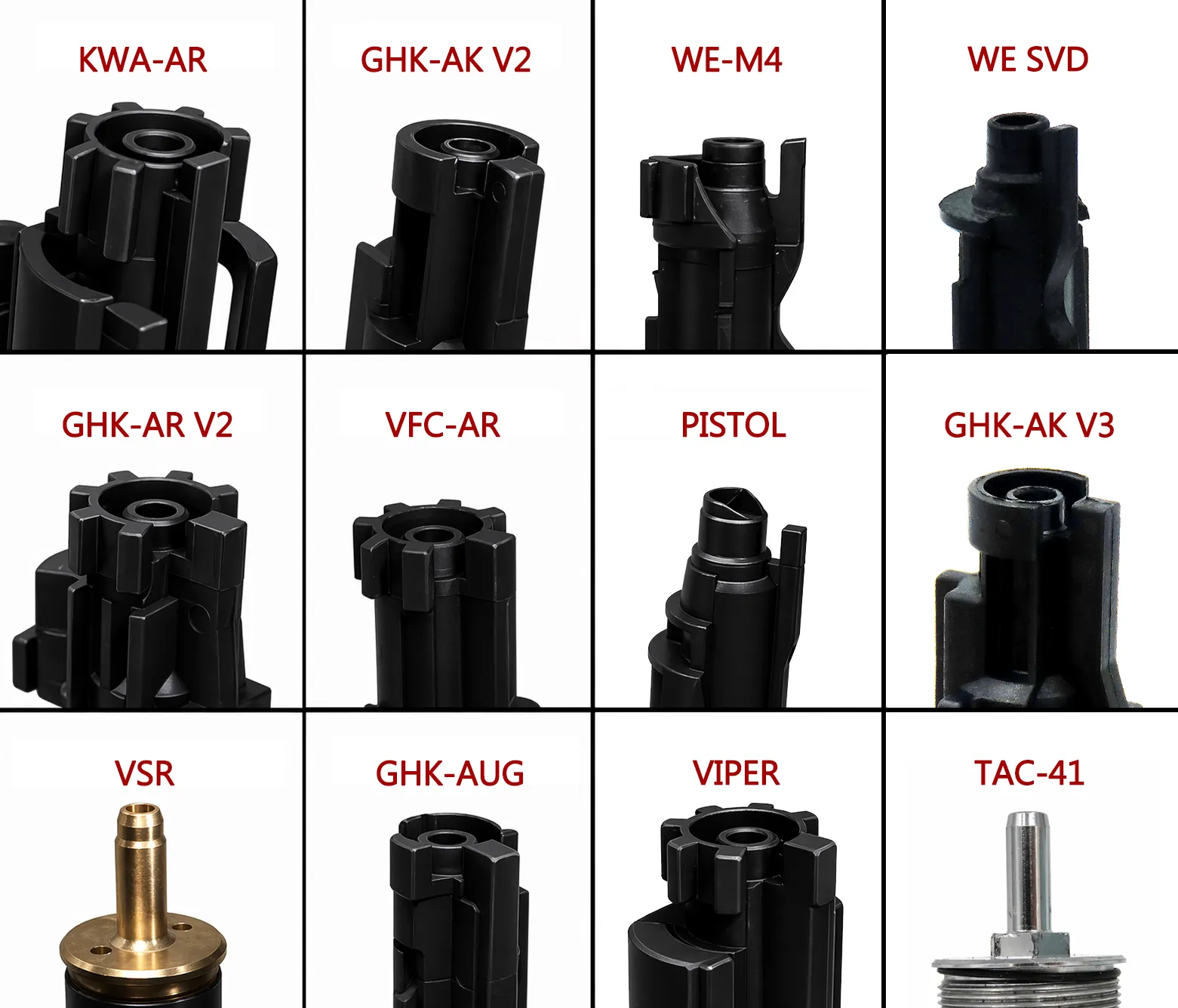
BB Positioning Is More Important Than Most Players Realize
Different airsoft platforms vary in:
● Nozzle length
● Feeding geometry
● BB feeding angle
● Manufacturing tolerances
These differences directly affect the final position of the BB once it is chambered inside the bucking.
Many players assume that as long as the HOP-UP system applies enough spin, performance will be satisfactory. In reality, even with highly consistent FPS readings, slight variations in BB positioning can result in:
● Horizontal deviation
● Inconsistent trajectories
● Reduced FPS repeatability
● Poor heavy BB performance
● Larger groupings at longer distances
This is why some rifles may achieve adequate range yet still struggle to deliver consistent accuracy.
Backspin Is Not Created Instantly
Many players view the HOP-UP system simply as a mechanism that applies spin to the BB.
In reality, backspin is generated progressively as the BB travels through the contact patch.
This process can generally be divided into three stages.
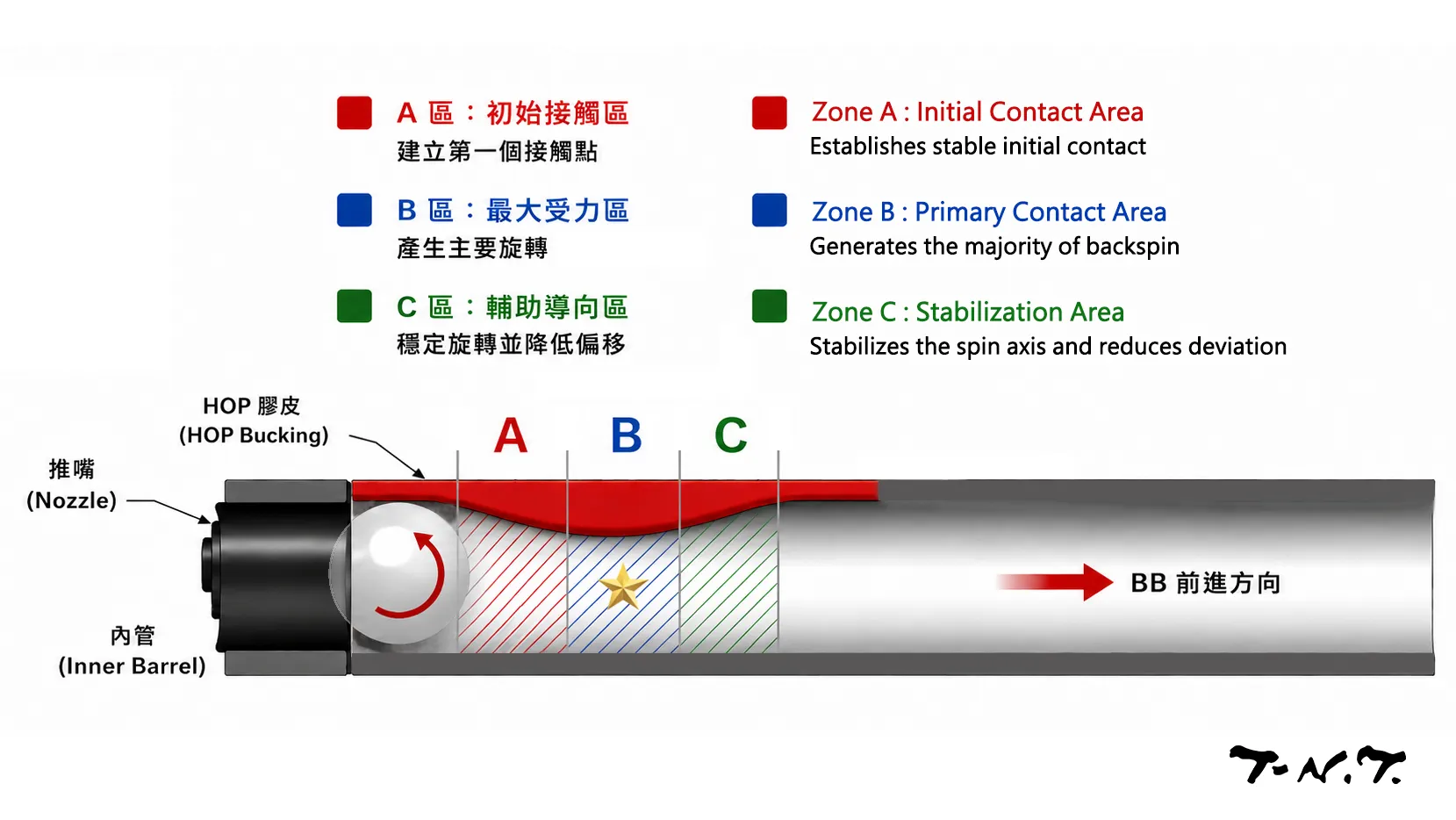
Zone A | Initial Contact Area
This is where the BB first contacts the bucking.
The primary purpose of this area is to establish stable contact between the BB and the HOP patch.
If the BB enters off-center or at an improper angle, it may lead to:
● Misaligned spin axis
● Horizontal drift
● Unstable flight characteristics
Zone B | Primary Contact Area
This is the most critical area for generating backspin.
Within this section:
● Contact surface area is greatest
● Friction is highest
● Most rotational force is generated
As a result, BB positioning becomes extremely important.
If the BB is not centered beneath the contact patch, increasing HOP pressure alone may cause:
● Uneven spin generation
● Trajectory deviation
● Excessive wear
● Inconsistent flight behavior
Zone C | Stabilization Area
By the time the BB reaches this section, most of the backspin has already been established.
The purpose of this area is to:
● Stabilize the spin axis
● Reduce eccentric rotation
● Improve long-range consistency
● Increase shot-to-shot repeatability
This becomes even more important when using heavier ammunition such as:
● 0.36g / 0.40g / 0.45g / 0.48g and above
Why Does T-N.T. Develop Platform-Specific Buckings?
The answer is simple:
Different platforms use different nozzle lengths and feeding systems.
If identical buckings are used across all platforms, the final resting position of the BB can vary significantly.
Even small positioning differences can alter how the BB contacts the HOP patch.
For this reason, every T-N.T. HOP-UP system is designed with platform-specific adjustments to optimize:
● Bucking length
● Contact position
● Internal dimensions
● BB positioning
● HOP patch alignment
Our goal is to ensure that every BB is positioned directly beneath the HOP contact patch while maintaining proper alignment with the bore axis.
We Pursue Stable Spin, Not Simply More Pressure
Many modern HOP-UP products focus on:
● Larger contact patches
● Increased pressure
● Greater friction
While these factors can be beneficial, we believe the true key to accuracy lies elsewhere.
The most important factor is not how much pressure is applied, but how consistently the spin is generated.
If the BB enters the contact area from a different position every shot, even the most aggressive HOP design cannot achieve optimal results.
Therefore, T-N.T. focuses on the complete system, including:
● BB positioning accuracy
● Feeding centerline alignment
● Nozzle-to-BB alignment
● HOP patch placement
● Bucking dimensions
● Inner barrel concentricity
Because consistent backspin can only be achieved when the BB begins from a consistent position.
The T-N.T. Design Philosophy
Every T-N.T. dedicated bucking is designed around the feeding geometry and nozzle position of a specific platform.
The purpose is not to complicate installation.
The purpose is to deliver:
● More consistent trajectories
● Improved shot-to-shot accuracy
● Tighter groupings
● Better heavy BB performance
● More predictable flight paths
For us, HOP-UP performance is not determined by a single component, but by how the entire system works together. Dedicated buckings ensure the BB is positioned correctly from the start, allowing consistent backspin generation and unlocking the full potential of the system.
※ Some HOP-UP chambers remain compatible with standard buckings after testing. Please refer to the product description for details.